Building the Solution: Clues That Lead, Red Herrings That Mislead
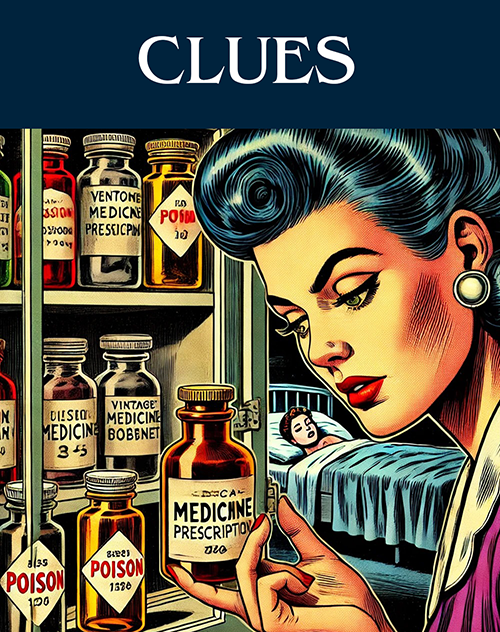
What Are Clues in a Murder Mystery?
Clues are pieces of evidence that lead to the correct solution. They must be visible to the reader, even if their meaning is misunderstood
Tangible Clues (Physical Evidence)
These are concrete, sensory details the reader can observe:
- Objects (a weapon, a note, a missing item)
- Physical traces (fingerprints, footprints, damage)
- Observable actions or events
Use to Anchor your mystery in reality & Give the investigation something to examine and test
Intangible Clues (Logical or Behavioral Evidence)
These are patterns or inconsistencies the reader must interpret:
- Contradictions in alibis
- Illogical timelines
- Character behavior that doesn’t match the situation
Use to Reward attentive readers who notice what doesn’t add up & Create intellectual engagement
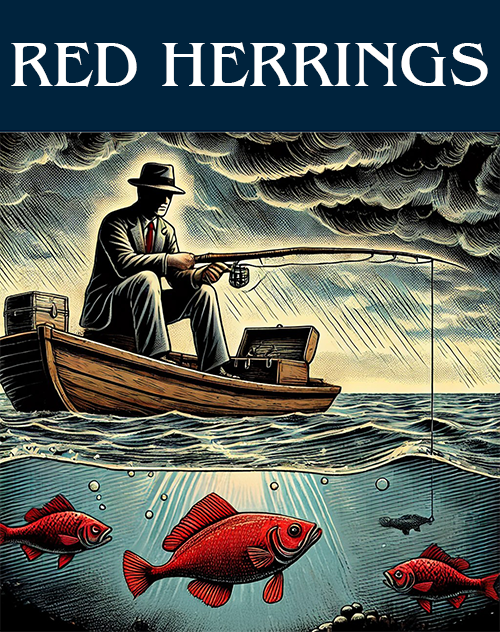
What Are Red Herrings in a Murder Mystery?
Red herrings are false clues that lead the reader away from the true solution.
How Do Red Herrings Work?
- Supports a believable but incorrect theory
- Fits the facts on the surface
- Can be reinterpreted later as misleading or incomplete
In other words, a red herring must be true in appearance, false in conclusion.

What Is a “Fair Play” Murder Mystery—and How Does It Work?
A fair play murder mystery gives the reader a genuine chance to solve the crime before the final reveal. The solution is not hidden—it is constructed from clues that are deliberately placed, clearly presented, and logically connected. This is not real life. It is a designed system. As the writer, you control the stage: every object, every action, and every piece of information exists to support a solvable outcome.
In a fair play mystery, the detective does not magically discover the truth—the truth is already there. The investigation works because the clues have been carefully embedded into the story. The reader follows the same path as the detective, encountering the same evidence, but may interpret it differently. The satisfaction comes when the final reveal shows that the answer was always visible.
ADVICE from the EXPERTS
Save yourself some valuable time and unnecessary headaches by taking some writing advice from those who have already done the work and had the insights. Using the wisdom of others is a sign of wisdom in yourself. Listen to what these experts are happy to share. Writing can be a long journey – may as well use the shortcuts available.
Sir Arthur Conan Doyle / Sherlock Holmes
“It is an old maxim of mine that when you have excluded the impossible, whatever remains, however improbable, must be the truth.”
Frank Herbert
“If a man lies about an apparently inconsequential thing, then that thing is not inconsequential.”
Rex Stout / Nero Wolfe
“There are two ways to catch a criminal: one, connect him with the crime itself; or two, prove that he knowingly took a share of the spoils.”
Rex Stout / Nero Wolfe
“A search for negative evidence is a desperate last resort when no positive evidence can be found. Collecting and checking alibis is dreary and usually futile drudgery. No. You get positive evidence and if you find it confronted by an alibi, and if your evidence is any good, break the alibi.”
Harry Kemelman
“(The percentage of error is particularly high in the legal profession where) … the intention is not to discover what the speaker wishes to convey, but rather what he wishes to conceal.”
S.S. Van Dine pseudo. For Willard Huntington Wright
“The truth of the problem must at all times be apparent – provided the reader is shrewd enough to see it.”
Agatha Christie / Jane Marple
“What you have to account for is if one person did see something why didn’t that person say so? … Possibility one. The person who saw it didn’t realize what they had seen. That would mean, of course, that it would have to be rather a stupid person. some, let us say, who can use their eyes but not their brain. … It might have been a person whose action in putting something in a glass was natural. It would be quite possible, audacious but possible, for someone to pick up that glass which as soon as it was in his hand or her hand, of course, would be assumed to be his or her own drink and to add whatever was added quite openly. In that case you see, people wouldn’t think twice…it would be a gamble, a risk, but it could happen…Possibility three…Somebody saw what happened and held their tongue deliberately … if so, it’s a very dangerous thing to do.
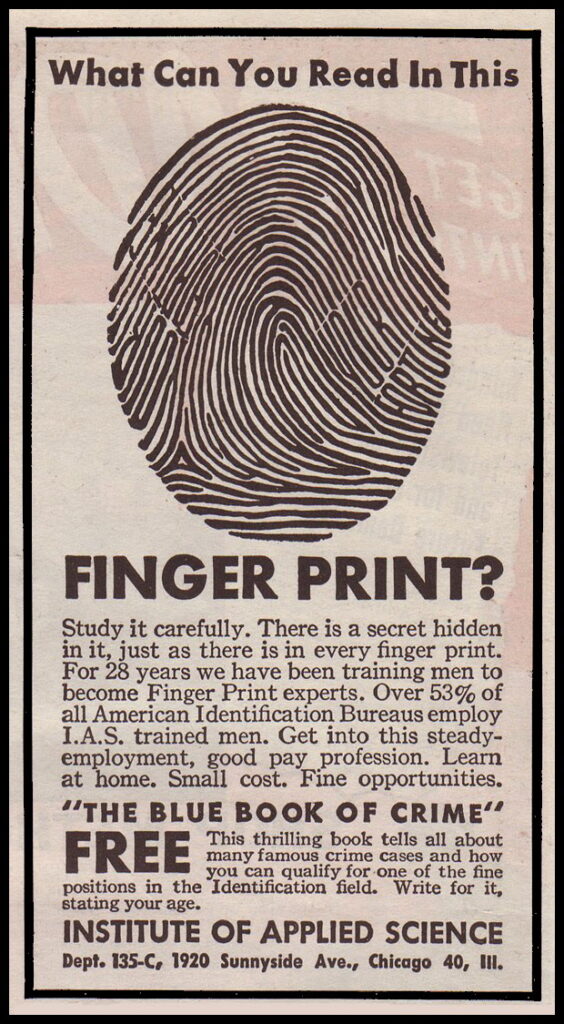
Look closely at the large fingerprint below. Can you find the words hidden there?